Mavericks of Italian Cinema by Roberto Curti
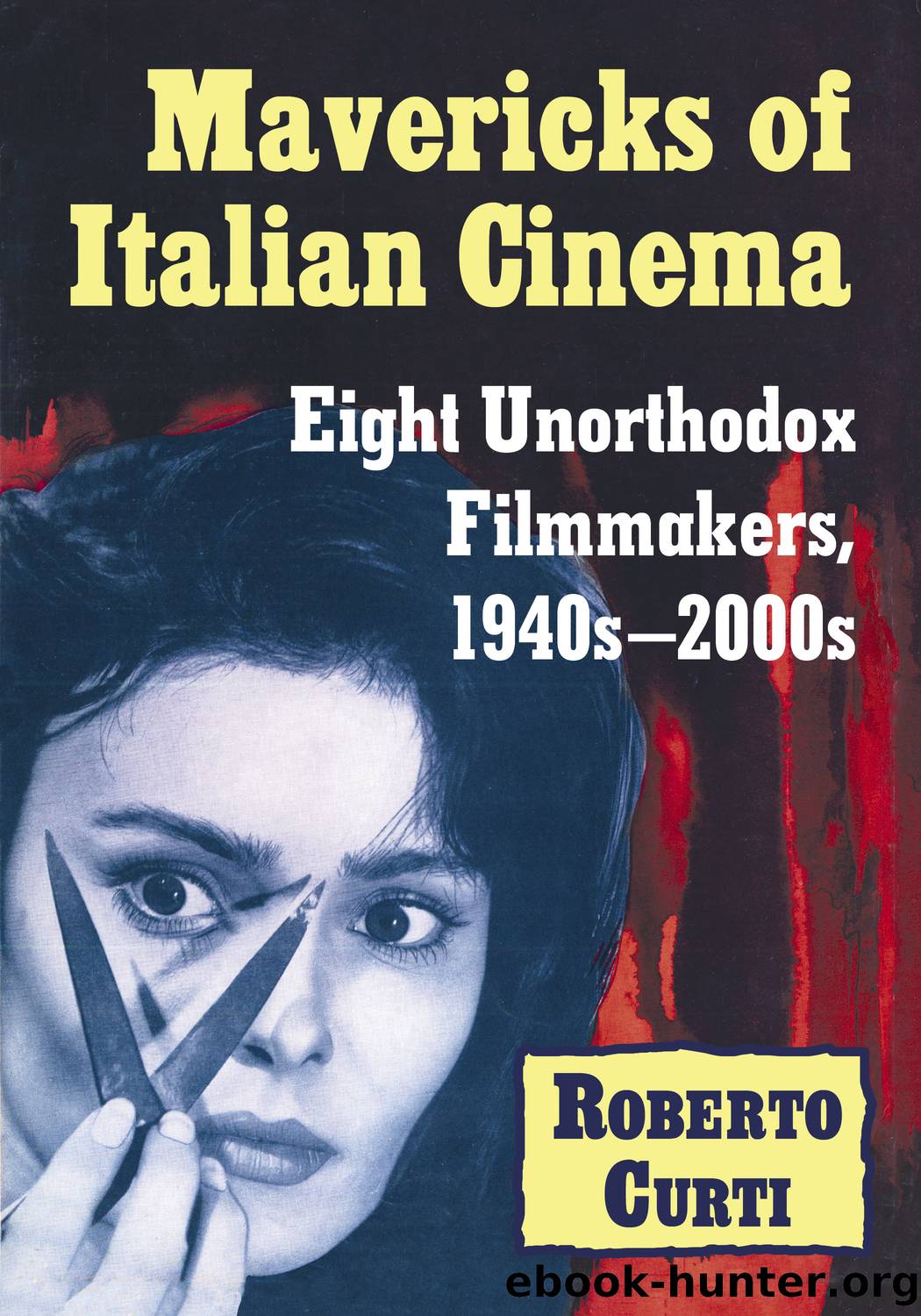
Author:Roberto Curti
Language: eng
Format: epub
Publisher: McFarland & Company, Inc., Publishers
Published: 2018-05-14T00:00:00+00:00
Italian poster for Arcana (1972) (art by Enrico De Seta).
Soon, however, disagreements began. Giulio wanted to make a film with young and unknown actors, while Ponti wanted to impose his protégée Dalila Di Lazzaro. Moreover, one year passed in useless discussions, with Ponti insisting that Giulio and Kim change the script, and discard a part which he found too daring. One of the boys drowns in an oil mill; his friends recover the body and take him with them, in their car; then they come across a prostitute, and pay her to perform oral sex on the dead man. To Questi, the scene meant âa stubborn rebellion against the commonplaces tied to the notion of death, which I did not want to lose.â His refusal of a compromise led to defeat: after the umpteenth stormy meeting, Ponti kicked him off the project. The movie (retitled LâItalia sâè rotta) was eventually directed by Steno in 1976, starring Di Lazzaro, Teo Teocoli and Enrico Montesano. Questi was credited as the co-author of the story, and he and Arcalli were listed as co-authors of the title song with Enzo Jannacci, but the script had been rewritten from scratch by the director with Sergio Donati and Luciano Vincenzoni. Giulio never even saw the movie.
The disappointing experience of Fichi dâIndia was the straw that broke the camelâs back. Giulio and Marilú moved to the island of Baru, in Colombia, where she had purchased a hectare of land and built a small cottage, with no electricity or running water. It was Giulioâs shelter, the cure from the delusions of filmmaking. He would divide his time between Italy and South America, where he had some illustrious friends, such as novelist Gabriel GarcÃa Márquez and actor Kabir Bedi. But running away from Italy was also the sign of a deeper political disillusionment, in a period when Italy was stained red with terrorism and political killings. Even though it didnât belong to Giulio, the title LâItalia sâè rotta (Italy Has Broken Up) perfectly fit his feelings toward his home country at that time.
Back and forth from his private exile in Baru, Questi worked on more film projects, but with no luck. One was an adaptation of Alberto Moraviaâs novel Lâattenzione, to be produced by Alberto Senatore, the man who had financed Petriâs Indagine su un cittadino al di sopra di ogni sospetto. But despite the latterâs big plans, such as having Richard Burton in the lead, it soon turned out that Senatore simply didnât have the money to put the film together. Another idea, a throwback to Questiâs early days, was a two-part documentary on the Indios of the rainforest. Then there was Sierra Nevada, a story about cocaine smuggling set between the titular mountain in Venezuela and New York. Senatore was enthusiastic about that, and once again Questi decided to trust him. The director and the producer flew to New York circa 1976 and set up an office, and while Senatore scouted for financing, Giulio lived the nightlife in the city of a thousand lights.
Download
This site does not store any files on its server. We only index and link to content provided by other sites. Please contact the content providers to delete copyright contents if any and email us, we'll remove relevant links or contents immediately.
4 3 2 1: A Novel by Paul Auster(12405)
The handmaid's tale by Margaret Atwood(7773)
Giovanni's Room by James Baldwin(7354)
Big Magic: Creative Living Beyond Fear by Elizabeth Gilbert(5780)
Asking the Right Questions: A Guide to Critical Thinking by M. Neil Browne & Stuart M. Keeley(5779)
Ego Is the Enemy by Ryan Holiday(5455)
The Body: A Guide for Occupants by Bill Bryson(5103)
On Writing A Memoir of the Craft by Stephen King(4948)
Ken Follett - World without end by Ken Follett(4740)
Adulting by Kelly Williams Brown(4582)
Bluets by Maggie Nelson(4565)
Eat That Frog! by Brian Tracy(4546)
Guilty Pleasures by Laurell K Hamilton(4455)
The Poetry of Pablo Neruda by Pablo Neruda(4113)
Alive: The Story of the Andes Survivors by Piers Paul Read(4037)
White Noise - A Novel by Don DeLillo(4018)
Fingerprints of the Gods by Graham Hancock(4009)
The Book of Joy by Dalai Lama(3996)
The Bookshop by Penelope Fitzgerald(3857)
